Company News
How ZYE Tests Every CO2 Laser Power Supply: Quality Control, Aging, and What Buyers Should Ask
A CO2 laser power supply drives a glass laser tube with 26 kV to 36 kV — voltage levels that will destroy a tube, a controller board, or a workpiece in milliseconds if the supply behaves unpredictably. When a cutting job stops mid-run and the material is ruined, the buyer rarely knows whether the fault was the tube, the controller, or the power supply itself. What they do know is that the machine lost money.
Quality control is the part of a power supply you never see on a spec sheet. Output voltage and current are printed on the label; the test process behind them is not. This article explains what is actually tested on every CO2 laser power supply before it ships, how ZYE structures its quality control around the ISO9001 standard, and which questions buyers should ask any supplier to verify that the process is real.
Why Quality Control Decides Long-Term Cost
For a high-voltage switching power supply, the price difference between a well-built unit and a cheap one is often small — sometimes US$10–30 at the same wattage. The difference in failure rate is not small at all. A supply that fails at month 8 costs the buyer: the replacement unit, the shipping, the downtime, and often a laser tube that died with it. That is why serious machine manufacturers evaluate power supplies on total cost of ownership, not unit price.
Quality control is not about catching dramatic failures. It is about catching the small deviations that become failures later — a capacitor with marginal ESR, a solder joint that passes an electrical test today but cracks under thermal cycling next month, a current regulation drift of 0.5 mA that slowly over-drives the tube.
What Is Tested on Every CO2 Laser Power Supply
A proper test process for a CO2 laser PSU covers more than "does it turn on." The table below summarizes the standard tests used across the industry for this class of high-voltage constant-current supply:
| Test | What it checks | Failure it prevents |
|---|---|---|
| High-potential (hi-pot) test | Insulation strength between mains input, high-voltage output, and chassis under elevated voltage | Arcing, electric shock, breakdown during operation |
| No-load start-up | Clean output high voltage without a tube connected, no oscillation or crowbar | Tube damage during installation and first firing |
| Current regulation accuracy | Output current matches the set value across the adjustment range | Inconsistent cut/engrave depth, tube over-drive |
| Load and ripple test | Current stability under a simulated tube load; output ripple within tolerance | Flicker in the beam, banding on engraved surfaces |
| Protection function test | Over-voltage, over-current, and short-circuit protection trigger correctly | Damage to the PSU and tube under fault conditions |
| Control signal test | TTL/PWM and analog inputs switch the output correctly and within response time | Failed firing, missed pulses at high engraving speed |
| Aging (burn-in) | Continuous operation at rated load for a defined period | Early-life failures (see next section) |
| Final inspection | Connector tightness, terminal labels, enclosure, packing | Field failures caused by assembly and transport |
What the tests mean for real machines
Each test maps to a real failure a user would otherwise encounter in the field:
-
Hi-pot testing matters because a CO2 laser power supply is a High Voltage CO2 Laser PSU by design. On the MYJG line, output reaches 26 kV on the MYJG80W model and up to 36 kV on the 180 W units. If insulation is weak, the supply can arc internally or leak to the chassis — a hazard that no amount of software protection can fix. A grounding check during installation cannot compensate for a unit that was never hi-pot tested.
-
Current regulation accuracy matters because a CO2 laser tube's life is measured in current, not in power. The ZY series controllers hold TTL response to 0.5 ms or less; that precision is meaningless if the regulated current itself drifts between tubes or over temperature. Stable current is what keeps a 100 W tube delivering consistent power at month 30, not just at week 1.
-
Protection testing matters because the supply must fail safely. A glass laser tube is a gas discharge device — when it nears end of life, its internal characteristics change and it can demand abnormal current. The protection circuits in the MYJG CO2 Laser Power Supply and ZY lines are tested to shut the unit down rather than force current into a dying tube.
Inside ZYE's Quality Control Process
ZYE has manufactured CO2 laser power supplies since 2007 and follows the ISO9001 quality management system in its production, with CE compliance on the product range. The manufacturing side is organized around three production lines, with a dedicated QC team of 5–10 inspectors among a total staff of 5–50 — a ratio that reflects the reality that in power supply manufacturing, testing is a labor-intensive stage that cannot be automated away. The company's own June 2026 announcement on its factory relocation named improved production efficiency, quality control, and product testing as the explicit goals of the move — an indication that QC investment is treated as a production priority rather than a paperwork exercise.
The company has published several short factory videos that let buyers see the process directly rather than take a sales claim on faith:
- Automated PCB assembly equipment in operation — showing the SMT stage where component placement consistency is machine-controlled.
- CO2 laser power supply inspection and batch testing — showing units being verified in batches before packing.
- CO2 laser power supply assembly and packing preparation — the final stage before units leave the factory.
Buyers who want proof of process should ask for these videos or request a live walkthrough on a video call. A manufacturer that is proud of its QC process will show it; one that is not will redirect the conversation to price.
ISO9001 and what it actually guarantees
ISO9001 does not certify that a product is good. It certifies that a company's processes are documented, followed, and audited — that the same test steps are performed on unit #1 and unit #10,000, and that when something goes wrong there is a corrective-action trail. For a buyer sourcing CO2 Laser Power Supply units in volume, process consistency matters more than a heroic one-off sample. A batch of 500 units that are all 98% good is worth more than 50 units that are 100% good and 450 that are untested.
Aging Tests: Catching the "Infant Mortality" Failures
The single most valuable test in power supply manufacturing is the aging test (burn-in). It exists because electronic components follow the bathtub curve:
Failure rate
     │
  ┌──┤                    ┌────────────
  │  │  Early-life      │   Useful life      │ Wear-out
  │  │  failures        │   (low, flat)      │ failures
  └──┴──────────────────┴────────────────────┴──►  Time
      aging test           months/years
      catches these
A small percentage of units fail early, not because of a design flaw, but because of weak components — a capacitor with a marginal batch, a solder joint with a micro-crack, a semiconductor with a latent defect. Most of these failures appear within the first hours of operation under load. Running every unit at rated load for a defined period pushes these weak units to fail on the test bench, where the cost is a rework, not a customer complaint.
This is why buyers should treat "100% aging tested" differently from "batch tested" or "random sampled." The engineering rationale is simple: an untested unit that survives a week in the customer's machine might be fine for years — but the units that fail early fail fast, and the test exists to make sure they fail at the factory.
When you receive a replacement supply for an existing machine, the same logic applies in reverse: a CO2 laser PSU replacement that arrives with infant-mortality risk means a second round of downtime for a machine that is already down. Confirming the manufacturer runs aging on every unit is a legitimate pre-order question.
What a Factory Test Report Should Show
If a supplier runs a real QC process, they can produce a test report for a batch — and the format of that report tells you as much as its content. A credible report records the following for every model tested:
- Unit identification — model, rated output, and batch or serial number range.
- Input conditions — the exact AC input voltage and frequency used for the test (110 V and 220 V units must be verified at the voltage the buyer will actually use).
- No-load output — measured high voltage without a tube connected, confirming clean start-up.
- Regulated current at set points — output current measured at minimum, mid, and maximum adjustment, confirming the constant-current loop holds its value.
- Aging record — duration, load condition, and ambient temperature of the burn-in run.
- Protection checks — which protection functions were triggered and confirmed (over-voltage, over-current, short-circuit).
- Test date and operator — traceability back to a person and a test station.
Buyers sourcing in volume should request this report with the commercial invoice for each batch. A supplier who treats QC as a genuine production stage will provide it as routine documentation; one who treats it as a marketing phrase will struggle to produce a file that contains anything beyond the model name and a pass stamp. The distinction between the two is worth more than a US$5 unit-price difference.
Six Questions Every Buyer Should Ask Any Manufacturer
Since a spec sheet cannot show you a test process, here is a practical verification checklist to use with any supplier — including ZYE:
- "Do you run a 100% functional test on every unit, or only sample testing?" — The answer distinguishes a process-oriented factory from an assembly shop.
- "Do you run aging/burn-in on every unit? At what load and for how long?" — Any serious manufacturer should be able to state this without hesitation.
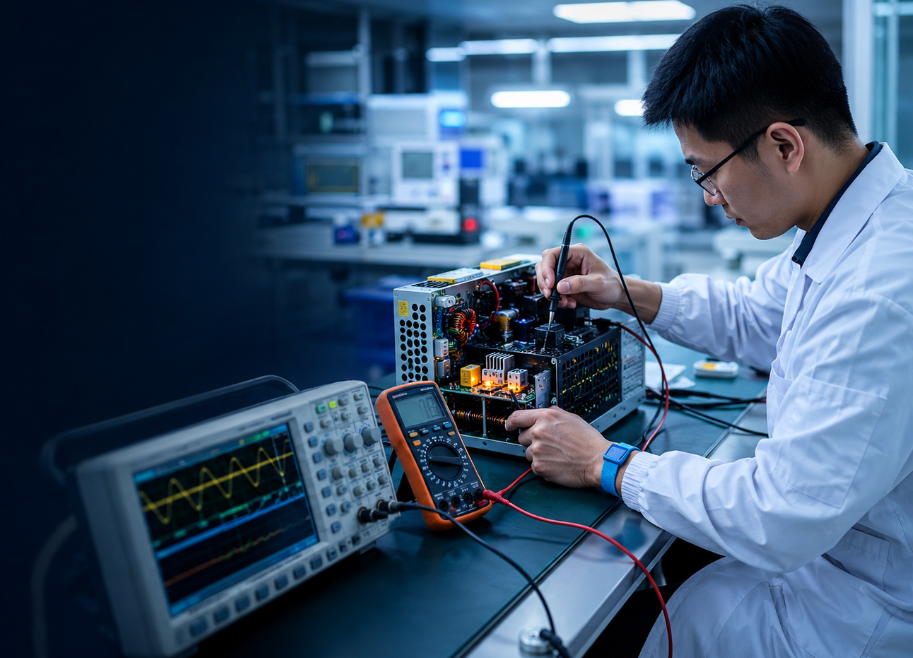
- "What test equipment do you use, and can I see the test station on a video call?" — A real test bench with a load, an oscilloscope, and a hi-pot tester is hard to fake.
- "What is your field failure rate, and how do you track returns?" — A manufacturer with real QC data will quote a figure; a trader will not have one.
- "Which certifications apply — CE, ISO9001 — and can you share the certificates?" — Certificates are documents; any factory can show them. The question is whether the process behind them is real.
- "What does your warranty cover, and what is the replacement process?" — Warranty terms are a proxy for the manufacturer's own confidence in its QC.
These questions apply whether you are buying a single unit for a shop upgrade or integrating supplies into machines you sell. For machine builders, the stakes are higher: a power supply failure in the field becomes your warranty claim, so the manufacturer's test process is directly your risk.
What This Means for Your Buying Decision
The three ZYE series differ in tube optimization and form factor, but they all leave the factory through the same ISO9001-framed process — the LL Series power supply line for compact industrial systems, the RECI-optimized ZY line, and the full-range MYJG line. When a buyer asks "which series should I choose," the answer depends on the tube and the application. When a buyer asks "why should I trust this factory," the answer is the process described above — and the willingness to show it.
Quality control is not a spec. It is a behavior. Verify the behavior before you place the order, and the unit that arrives will be the one that keeps cutting for years.
Need the QC documentation for a specific model? Ask for the test report and factory videos when you send an inquiry — ZYE's engineering team can walk you through what is tested on the model you are sourcing. Contact: klee@zyelaser.com | Phone Number: +86-13869159009